 Classroom
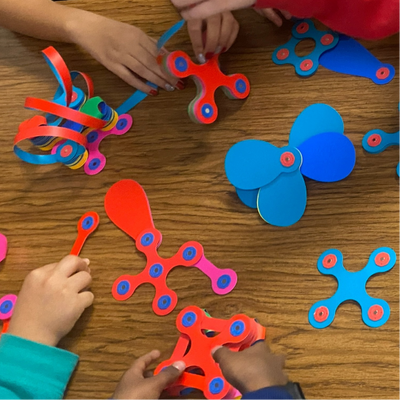
Clixo Patterns
Students will explore the concept of A/B, A/B/B, and A/B/C patterns using Clixo pieces.
Download PDF Grades K–2
Activity Overview
Students will explore the concept of patterns by using Clixo pieces to create and understand simple A/B, A/B/B, and A/B/C patterns. This hands-on experience helps young learners develop pattern recognition skills while fostering creativity and fine motor coordination.
Topics: STEAM, The World Around Us
Grade: Pre-K-2
Video runtime: 49 Sec
Objective
Students will explore the concept of patterns by using Clixo pieces to create and understand simple A/B, A/B/B, and A/B/C patterns. This hands-on experience helps young learners develop pattern recognition skills while fostering creativity and fine motor coordination.
Skills
- Creativity
- Problem solving
- Fine motor
- Collaboration
- Math
Materials
Introduce
Build and Create
Share & Reflect
Extension Activities
Educational Standards
K.MD.1Describe measurable attributes of objects, such as length or weight. Describe several measurable attributes of a single object.
K.MD.3Classify objects into given categories; count the numbers of objects in each category and sort the categories by count.
K.G.1Describe objects in the environment using names of shapes, and describe the relative positions of these objects using terms such as above, below, beside, in front of, behind, and next to.
K.G.2Correctly name shapes regardless of their orientations or overall size.
1.MD.4Organize, represent, and interpret data with up to three categories; ask and answer questions about the total number of data points, how many in each category, and how many more or less are in one category than in another.
1.G.1Distinguish between defining attributes (e.g., triangles are closed and three-sided) versus non-defining attributes (e.g., color, orientation, overall size); build and draw shapes to possess defining attributes.
2.OA.3Determine whether a group of objects (up to 20) has an odd or even number of members, e.g., by pairing objects or counting them by 2s; write an equation to express an even number as a sum of two equal addends.
2.OA.4Use addition to find the total number of objects arranged in rectangular arrays with up to 5 rows and up to 5 columns; write an equation to express the total as a sum of equal addends.
1.1.aArticulate and set personal learning goals, develop strategies leveraging technology to achieve them and reflect on the learning process itself to improve learning outcomes.
1.3.dBuild knowledge by actively exploring real-world issues and problems, developing ideas and theories and pursuing answers and solutions.
1.4.aKnow and use a deliberate design process for generating ideas, testing theories, creating innovative artifacts or solving authentic problems.
1.5.dUnderstand how automation works and use algorithmic thinking to develop a sequence of steps to create and test automated solutions.
1.6.cCommunicate complex ideas clearly and effectively by creating or using a variety of digital objects such as visualizations, models or simulations.
1.7.bUse collaborative technologies to work with others, including peers, experts or community members, to examine issues and problems from multiple viewpoints.