 Classroom
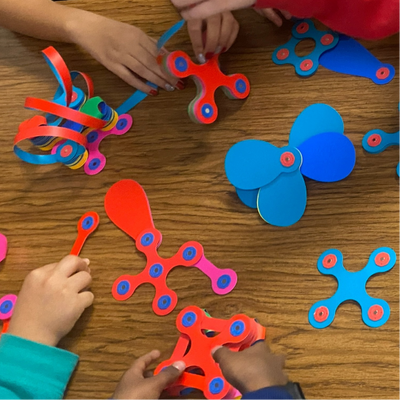
The Clixo Ball Run
Design and build a ball run using Clixo pieces, exploring concepts of physics, engineering, and creativity.
Download PDF Grades 1–5
Activity Overview
Students will design and build a ball run using Clixo pieces, exploring concepts of physics, engineering, and creativity. The activity encourages problem-solving, collaboration, and understanding of gravity, momentum, and angles.
Topics: Collaborative Play, Storytelling, The World Around Us, Accessibility and Inclusion
Grade: 1-2, 3-5
Video runtime: 40 secs
Objective
Students will design and build a ball run using Clixo pieces, exploring concepts of physics, engineering, and creativity. The activity encourages problem-solving, collaboration, and understanding of gravity, momentum, and angles.
Skills
- Understand basic principles of physics, including gravity, force, and momentum.
- Develop engineering skills by designing and constructing a functional ball run.
- Encourage creativity and innovation in problem-solving.
- Foster collaboration and teamwork among students.
Materials
Introduce
Build & Create
Share & Reflect
Extension Activities
Tips
Educational Standards
Empowered Learner (1a, 1d)Students articulate and set personal learning goals, develop strategies leveraging technology to achieve them, and reflect on the learning process itself to improve learning outcomes. Students demonstrate perseverance to solve problems by working to achieve their learning goals.
Innovative Designer (4a, 4b, 4c)Students use a variety of technologies within a design process to identify and solve problems by creating new, useful, or imaginative solutions. Students select and use digital tools to plan and manage a design process that considers design constraints and calculated risks. Students develop, test, and refine prototypes as part of a cyclical design process.
Creative Communicator (6a, 6d)Students choose the appropriate platforms and tools for meeting the desired objectives of their creation or communication. Students publish or present content that customizes the message and medium for their intended audiences.
CCSS.ELA-LITERACY.SL.1-5.1Participate in collaborative conversations with diverse partners about grade 1-5 topics and texts with peers and adults in small and larger groups.
CCSS.ELA-LITERACY.SL.1-5.5Add drawings or other visual displays to descriptions when appropriate to clarify ideas, thoughts, and feelings.
CCSS.MATH.CONTENT.1.MD.A.1Order three objects by length; compare the lengths of two objects indirectly by using a third object.
CCSS.MATH.CONTENT.2.MD.D.9Generate measurement data by measuring lengths of several objects to the nearest whole unit, or by making repeated measurements of the same object.
CCSS.MATH.CONTENT.3.G.A.1Understand that shapes in different categories (e.g., rhombuses, rectangles, and others) may share attributes (e.g., having four sides), and that the shared attributes can define a larger category (e.g., quadrilaterals).
CCSS.MATH.CONTENT.4.MD.A.2Use the four operations to solve word problems involving distances, intervals of time, and money, including problems involving simple fractions or decimals.
CCSS.MATH.CONTENT.5.MD.C.4Measure volumes by counting unit cubes, using cubic cm, cubic in, cubic ft, and improvised units.