All Activities
Grades 3–5

Design a Portable Emergency Shelter

by Heidi BarberDistrict Educational Technology SpecialistGoldsboro, NC

Design challenge for learners to create a portable emergency shelter

Download PDF Grades 3–5
Design a Portable Emergency Shelter
Download PDF

Activity Overview

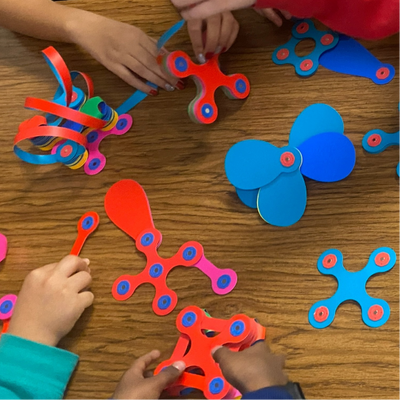
In this design challenge, learners create a portable emergency shelter using only Clixo pieces. Students build, test, and refine a structure within real-world design constraints, then share and justify their design decisions.

Objective

Build, test, and refine a structure within design constraints

Total Time

45 mins

Grade Level

Grades 3–5

Group Size

Pairs or small groups (2–4)

Skills

  • Prototyping
  • Spatial reasoning and geometric thinking
  • Creative problem-solving
  • Collaboration and communication
  • Explaining and justifying design decisions
  • Creative thinking within constraints

Materials

Introduce

5–7 minutes

  • Gather students and introduce the design challenge.
  • Present the scenario: After a natural disaster, communities often need temporary shelters that are quick to build, easy to transport, and strong enough to protect people from the elements.
  • Explain the challenge: Students must design a portable emergency shelter using only Clixo pieces.

Review design constraints:

  • The shelter must stand on its own.
  • It must include an enclosed or semi-enclosed space.
  • It must be flexible enough to bend or fold without breaking.
  • Encourage students to sketch or verbally plan before building.

Build and Test

20–25 minutes

  • Students build their first shelter prototype using Clixo.

Prompt groups to pause and test their design:

  • Does it stay upright?
  • Can it flex without collapsing?
  • Is there enough space for a person or supplies?
  • Allow time for revision and improvement based on testing.
  • Teachers circulate, asking guiding questions rather than giving solutions.

Share and Reflect

10–13 minutes

  • Each group presents their shelter to the class or a partner group.

Students explain:

  • How their shelter works
  • Which constraints were hardest to meet
  • What they changed after testing

Facilitate a brief reflection discussion or written response:

  • What would you improve if you had more time?
  • How could this design be adapted for different environments?

Optional Extension Activities

Math Extension

Calculate approximate area or perimeter of the shelter’s base.

Engineering Extension

Add a new constraint (wind resistance, limited pieces, faster assembly).

ELA Extension

Write a short proposal explaining why this shelter design should be selected for real-world use.

Technology Extension (ISTE)

Photograph or video the build process and annotate design decisions.

Tips

  • Encourage iteration — remind students that redesign is part of the process.
  • Avoid “right answers”; focus on reasoning and justification.
  • This activity works well in libraries and makerspaces with flexible seating.

Educational Standards

Download PDF