All Activities
Grades 3–5

Conditional Logic with Clixo

by Laurie GuyonLead Coordinator for Instructional TechnologyGansevoort, NY

Practice conditional reasoning and iteration by following IF-THEN rules to guide Clixo building decisions.

Download PDF Grades 3–5
Conditional Logic with Clixo
Download PDF

Activity Overview

Collaborative project for learners to construct a Clixo chain using conditional IF-THEN logic.

Objective

Practice conditional reasoning and iteration by following IF-THEN rules to guide Clixo building decisions.

Total Time

45 mins

Grade Level

Grades 3–5

Group Size

Pairs or small groups (3–6)

Topics

Skills

  • Conditional reasoning (IF-THEN logic)
  • Sequential thinking and turn-taking
  • Pattern recognition
  • Collaborative problem-solving
  • Debugging and iterative refinement
  • Visualizing algorithms and flowcharts

Materials

Introduce

10 minutes

  • Present the scenario: computer programs follow rules that check conditions and decide what happens next.

The computer checks a rule: “IF this is true, do this. If not, do something else.”

  • Look: What is happening right now?
  • Ask: “Is this rule true?” (Yes or no.)
  • Choose: If the answer is yes, it follows one instruction. If the answer is no, it follows a different instruction.
  • Do: Follow the rule and act.

Example

  • Imagine a robot deciding whether to bring an umbrella:
  • IF it is raining → bring an umbrella ELSE → leave the umbrella at home
  • The robot doesn't guess. It looks outside, asks “is it raining?”, chooses yes if it is raining, and does take the umbrella only if the answer is yes.

Build the Chain

20–25 minutes

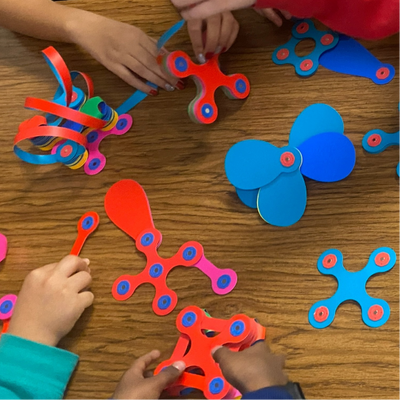
  • The first student starts a simple Clixo chain with one piece.

Each following student:

  • Looks at the last piece placed
  • Checks it against the three rules (the Conditional Statements)
  • Identifies the rule that is TRUE
  • Performs the required THEN action and adds their piece
  • Pass the chain around the group, repeating the check-and-build process.
  • If the creation doesn't hold up structurally (e.g., it collapses when asked to "stand up"), the group must debug: go back a step and rebuild before continuing.

Share and Reflect

10 minutes

  • The group presents the finished chain, tracing it piece by piece.

Students explain:

  • Which rule applied at each step
  • Where they had to debug and why
  • How the loop section felt different from the linear sections

Facilitate a brief reflection discussion or written response:

  • How is this like how a computer program runs?
  • What would happen if two rules were true at the same time?

Optional Extension Activities

Math Extension

Count how many times each rule was triggered; graph the frequency.

Computer Science Extension

Have students write their three rules as pseudocode (IF/THEN statements) before or after building.

ELA Extension

Write a short "program log" narrating the chain's build in sequence, using conditional language ("if... then...").

Tips

  • Post the rules where everyone can see them throughout the build.
  • Works well as a rotating-turn activity in classrooms, libraries, or makerspaces.
  • Photograph the finished chain and flowchart stages side by side for documentation.
  • Encourage students to say the rule out loud before acting — this reinforces the logic, not just the building.

Educational Standards

Download PDF