All Activities
Grades K–2

Clixo Geometry Shapes

STEAM, The World Around Us

Download PDF Grades K–2
Clixo Geometry Shapes
Download PDF

Activity Overview

In this hands-on geometry activity, students will use Clixo flexible magnetic pieces to construct and explore basic 2D geometric shapes such as squares, rectangles, triangles, hexagons, octagons, pentagons, and diamonds. The activity is designed to be engaging and interactive, suitable for young learners in Kindergarten to 2nd grade. It is divided into five parts.

Objective

Introduce young students to basic 2D geometric shapes using Clixo flexible magnetic pieces and explore how their shapes and angles can change when manipulated.

Clixo Geometry Shapes

Total Time

60–75 mins

Grade Level

Grades K–2

Group Size

Pairs or small groups

Topics

Skills

  • Shape recognition
  • Understanding basic geometric properties
  • Introduction to angles
  • Spatial reasoning
  • Fine motor skills
  • Collaboration and teamwork

Materials

PrintableShape Cards Open PDF

Part 1: Identifying & Constructing Shapes

15 minutes

Objective: Introduce students to basic 2D shapes and their properties.

Activity:

  • Show students images or physical examples of each shape.
  • Have students use Clixo pieces to construct each shape.
  • Help students name each shape and discuss its properties (number of sides, corners).

Shapes:

  • Square: 4 equal sides, 4 right angles (90 degrees each)
  • Rectangle: Opposite sides are equal, 4 right angles (90 degrees each)
  • Diamond: 4 equal sides, opposite angles are equal
  • Triangle: 3 sides (regular - all sides are equal)
  • Pentagon: 5 sides (regular - all sides are equal)
  • Hexagon: 6 sides (regular - all sides are equal)
  • Octagon: 8 sides (regular - all sides are equal)

Part 2: Manipulating Shapes

15 minutes

Objective: Explore how shapes can change when manipulated.

Activity:

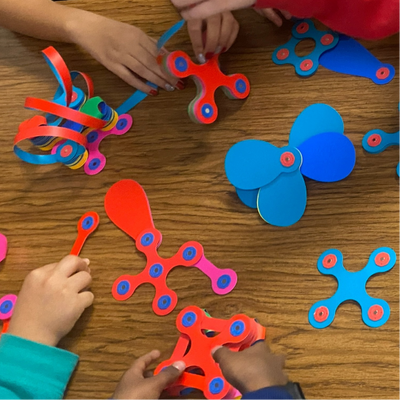
  • Using the shapes the students constructed out of Clixo pieces, ask students to bend and manipulate the shapes, observing how they can change form.
  • Discuss how the shapes look different when they are bent or manipulated.

Part 3: Creating New Shapes

10 minutes

Objective: Encourage creativity by combining shapes to form new shapes.

Activity:

  • Ask students to describe and name the new shapes they have created.
  • Discuss the properties of these new shapes (e.g., number of sides, corners).

Part 4: Shape Hunt in the Classroom

10-15 minutes

Objective: Help students recognize geometric shapes in their environment.

Activity:

  • Ask students to look around the classroom and identify objects that resemble the shapes they built with Clixo.
  • Have them point out and name objects that are similar to squares, rectangles, triangles, hexagons, octagons, pentagons, and diamonds.
  • Discuss how everyday objects can be related to geometric shapes (for example, a clock as a circle, a book as a rectangle).

Advanced:

  • Have students place their Clixo shapes on pieces of paper, and ask them to use them as a base to draw different objects (animals, buildings, foods, etc.)

Part 5: Reflection and Discussion

10-15 minutes

Objective: Reflect on observations and consolidate learning.

Activity:

  • Gather students to discuss what they learned.
  • Ask each to present the shapes they created and paper drawings with Clixo shapes.
  • Ask questions like:
  • Which shape was your favorite to make?
  • How did your shapes change when you bent them?
  • What new shapes did you create?
  • What classroom objects did you find that matched the shapes you built?
  • Summarize key points about shapes and encourage students to explore more with Clixo at home.

Conclusion

This activity guide will introduce young students to basic 2D geometric shapes and the concept of shape manipulation. Using Clixo makes learning interactive and fun, fostering both creativity and basic geometric understanding in young learners.

Tips

  • Encourage creativity and exploration.
  • Attach Clixo to the whiteboard/metal surface to show students examples of shapes using Clixo.
  • Allow students to work in pairs or small groups for collaborative learning.

Shape Cards

Print and cut out one set of cards for each group. Students build each shape with Clixo, then match it to its card.

  • Square: 4 equal sides, 4 right angles (90 degrees each)
  • Rectangle: Opposite sides are equal, 4 right angles (90 degrees each)
  • Diamond: 4 equal sides, opposite angles are equal
  • Triangle: 3 sides (regular: all sides are equal)
  • Pentagon: 5 sides (regular: all sides are equal)
  • Hexagon: 6 sides (regular: all sides are equal)
  • Octagon: 8 sides (regular: all sides are equal)
Square
Square
Rectangle
Rectangle
Diamond
Diamond
Triangle
Triangle
Pentagon
Pentagon
Hexagon
Hexagon
Octagon
Octagon

Educational Standards

Download PDF